
No products
Prices are tax included


Salt-free water softener: which electrostatic model should you choose?
- « Previous
- 1
- 2
- 3
- Next »
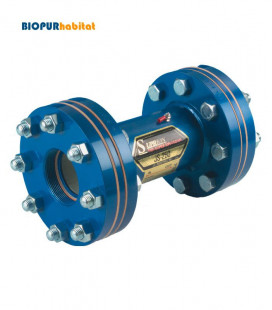
- 1 331,08 € tax incl. 1 401,14 € In StockReduced price!
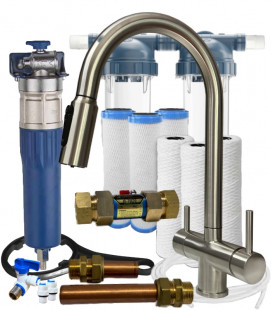
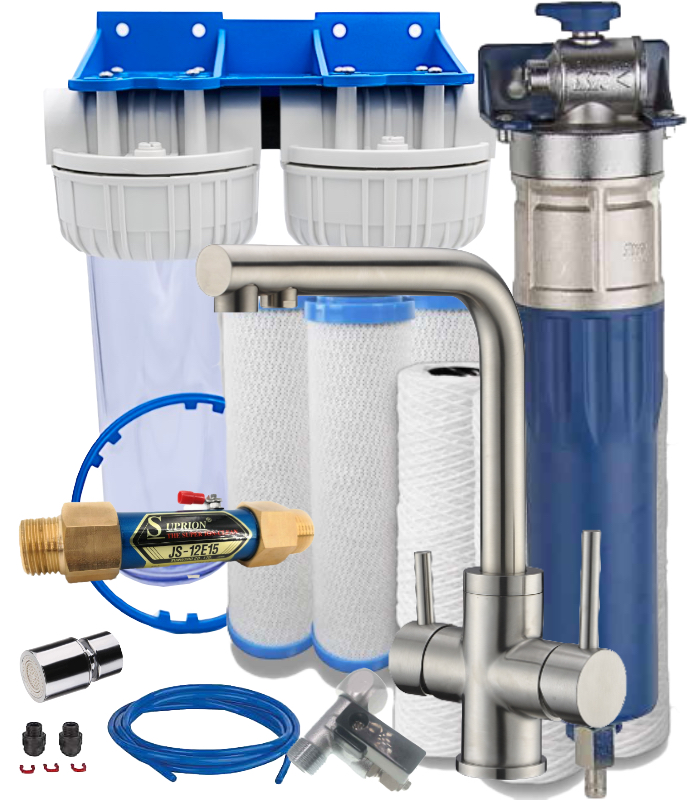
A comprehensive solution offering optimal ease of use: this pack combines a Suprion JS-75e22 salt-free water softener, a duplex filter (2 tanks) and a water purifier with a tap and shower head to combat the effects of limescale, filter the water and improve the quality of drinking water.
The hand shower makes it more flexible and convenient to use on a day-to-day basis, particularly in the kitchen.
- Electrostatic salt-free water softener (remedial solution)
- Duplex filtration (2 tanks): sediment + block carbon
- Water filter with tap and shower head
- Complete, ready-to-install solution
- 2 634,40 € tax incl. Stock in England delivery 10 to 15 days
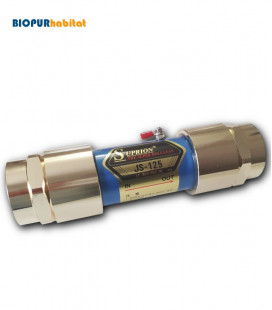
Suitable for pipes with a diameter of 32 mm.
The application of a strong electrostatic field to water is a major evolution in water treatment solutions.
WRAS certification, advised and guaranteed by the National Energy Distributor in the United Kingdom: British Gas
- 3 552,00 € tax incl. Stock in England delivery 10 to 15 days
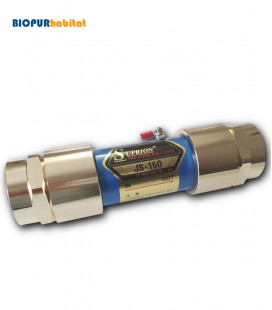
Suitable for pipes with a diameter of 40 mm.
The application of a strong electrostatic field to water is a major evolution in water treatment solutions.
WRAS certification, advised and guaranteed by the National Energy Distributor in the United Kingdom: British Gas
- 1 867,60 € tax incl. Stock in England delivery 10 to 15 days
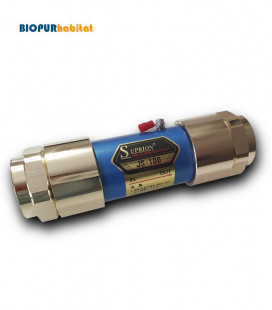
Fit and forget"
system Designed for a 25mm pipeThe application of a strong electrostatic field to water is a major evolution in water treatment solutions.
WRAS certification, advised and guaranteed by the National Energy Distributor in the United Kingdom: British Gas
- 0,00 € tax incl. Out of stockOut of stock
Suitable for pipe diameters from 50 to 450 mm.
- LARGE MODELS on order only
- ask us for the current price list for your projectThe application of a powerful electrostatic field to water is a major development in water treatment solutions.
WRAS certified, advised and guaranteed by the UK's National Energy Distributor: British Gas

- « Previous
- 1
- 2
- 3
- Next »
Salt-free water softener: which electrostatic model should you choose?
As an alternative to salt-based water softeners, the electrostatic salt-free water softener helps to minimise the effects of limescale without the need for extensive maintenance, without using salt, and without chemically altering the water.
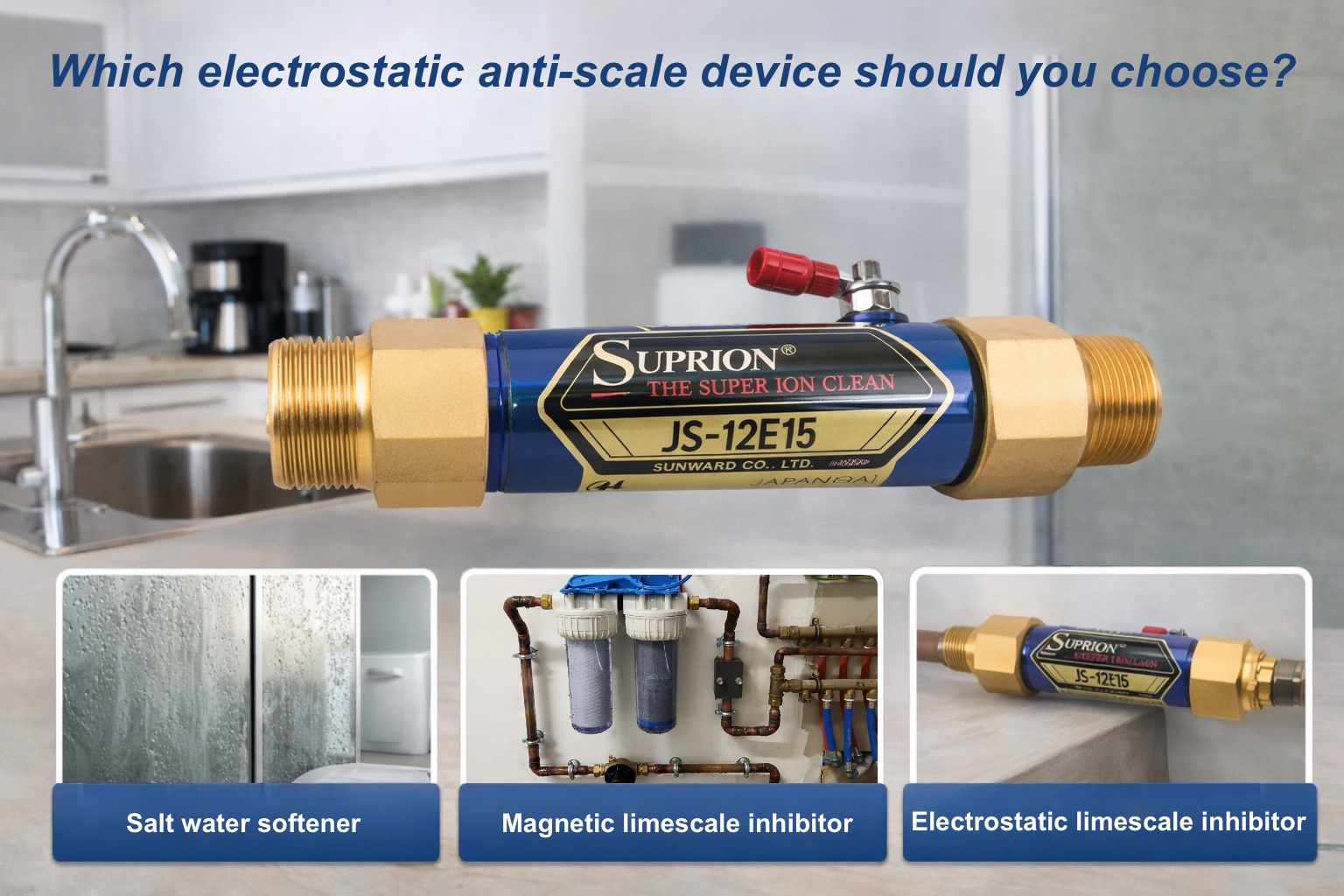
Hard water can cause a build-up of limescale throughout the home: limescale-covered taps, white deposits on shower walls, a clogged water heater, or household appliances that are less efficient.
To minimise these effects, several technologies are available: salt-based water softeners, magnetic limescale inhibitors, electronic limescale inhibitors and electrostatic limescale inhibitors.
What is an electrostatic salt-free water softener?
An electrostatic limescale inhibitor is a device fitted to the main water pipe in the house. It generates an electrostatic field when water flows through the unit, thereby acting on the mineral ions responsible for limescale.
This technology alters the structure of limescale so that it is less likely to build up in domestic plumbing systems.
Treating and preventing limescale
Not all anti-limescale technologies work in the same way. Some are purely preventative, whilst others also have a curative effect.
A corrective action means that the system can:
- to tackle limescale that has already built up in the pipes
- help reduce existing deposits
- gradually remove the thin layers of limescale that form when water sits in the pipes
How it works
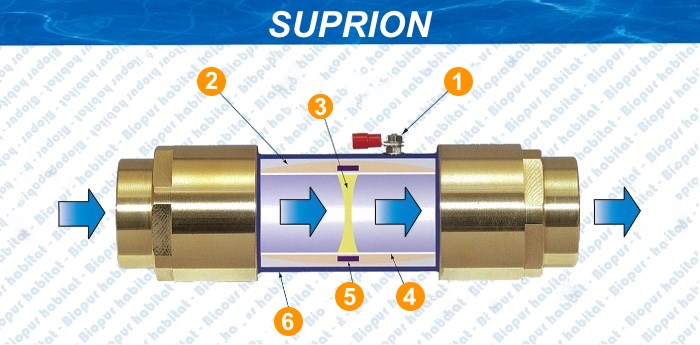
2. Primary electrostatic strip
3. Converging secondary electrostatic curtain
4. FRP tube for generating static electricity
5. Pair of electrodes
6. Housing
Electrostatic technology acts on the mineral ions present in the water to alter their behaviour. As a result, limescale crystals tend to remain in suspension rather than settling on surfaces.
Comparison of limescale prevention technologies
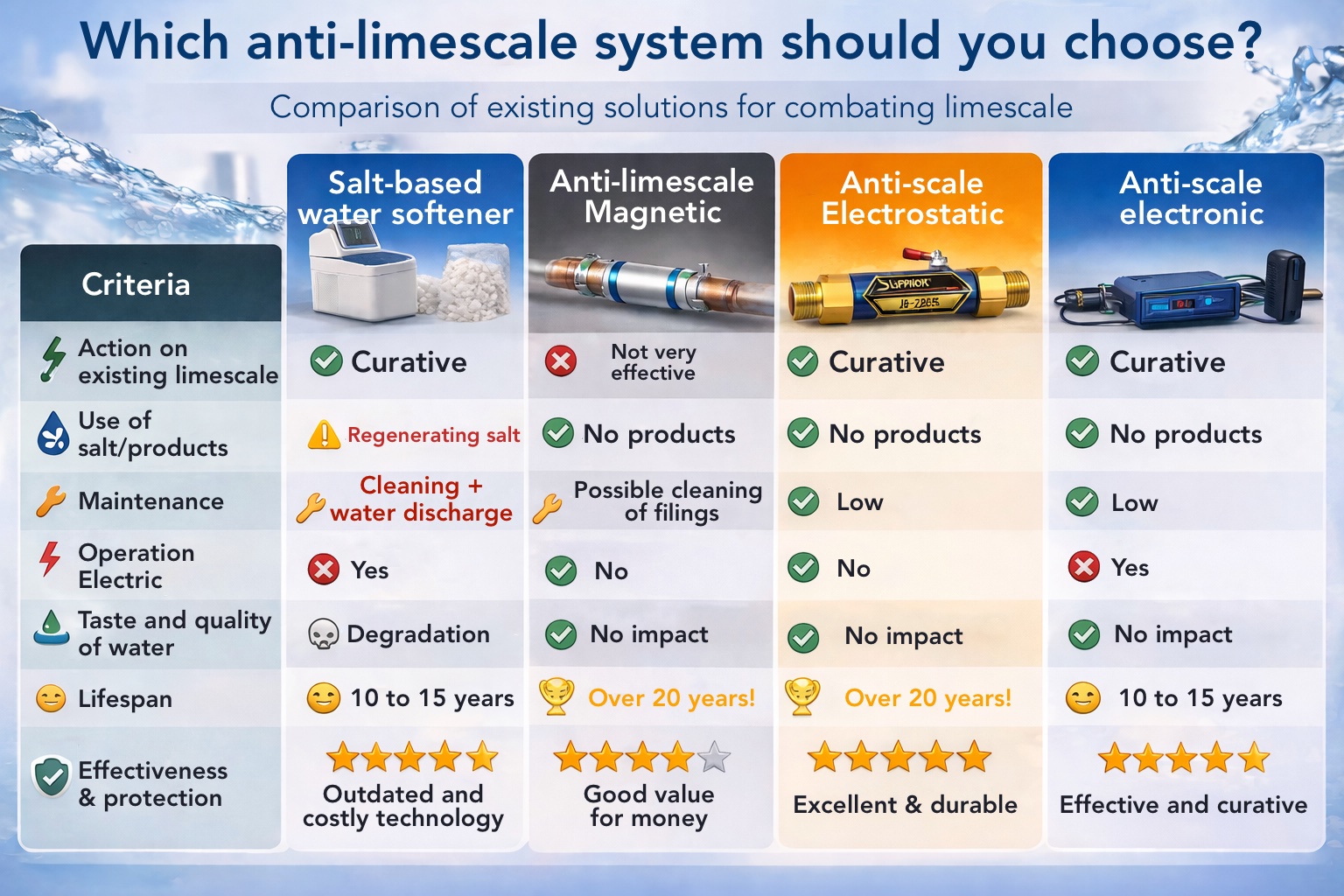
| Technology | Preventive action | Action curative | Maintenance / risk of breakdowns |
|---|---|---|---|
| Salt water softener | Yes | Yes | High maintenance |
| Electronic limescale inhibitor | Yes | Yes | Medium |
| Electrostatic salt-free water softener | Yes | Yes | Very low |
| Magnetic limescale inhibitor | Yes | No | Very low |
Electronic limescale inhibitor
Electronic limescale inhibitors perform just as well as electrostatic ones. It is therefore an effective system, whose only drawback is that it runs on electricity and is more susceptible to power surges. You should also be careful with the electronic components, as they do not fare well in damp conditions.
Salt-based water softener
Although this older technology has proven its worth, it remains expensive, bulky and requires a great deal of maintenance. Nor is it environmentally friendly, due to the salt water it discharges into the environment.
Contrary to what one might think, the water produced by this system tastes bad and is not good for your health.
It is even not recommended for people with high blood pressure, those on a salt-free diet, or those in poor health.
Please note that a TH level below 10°TH is not recommended by water safety authorities.
Magnetic limescale inhibitor: primarily a preventative solution
Magnetic systems use magnets to generate a magnetic field around the pipe. This technology is primarily used as a preventative measure to limit the formation of new deposits.
It is recommended that a filter be installed upstream of magnetic limescale inhibitors for one simple reason: over the course of many years, it is quite possible that iron oxides or metal filings may accumulate on the magnet.
Discover magnetic limescale removers
Electrostatic salt-free water softener: reliable, maintenance-free treatment and prevention
Unlike purely magnetic systems, the electrostatic limescale inhibitor has both a preventive and a curative effect. It can therefore tackle existing deposits whilst limiting the formation of new ones.
When should you choose electrostatic salt-free water softener?
- if your water is very hard
- if you want to reduce limescale build-up in your pipes
- if you're looking for a salt-free option
- if you’re looking for a simpler alternative to a traditional water softener
Installation on the main water supply
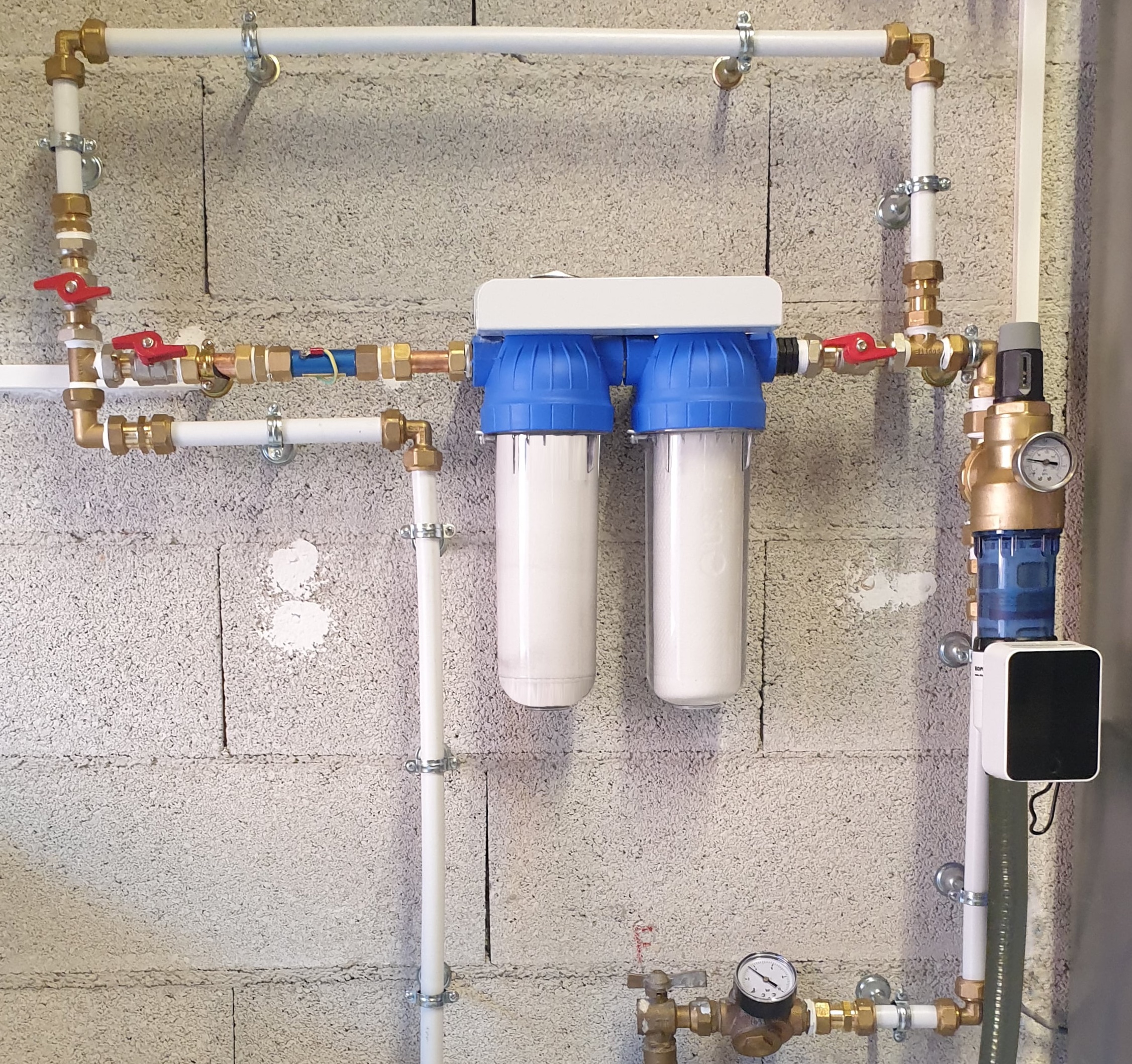
In most cases, the device is fitted to the main water supply to protect the entire domestic plumbing system: bathroom, kitchen, water heater and household appliances.
Proven technology
Manufactured in Japan for over 20 years, it is already being used successfully by major brands and organisations such as Toyota, Hitachi, Mitsubishi, Panasonic, the University of Tokyo, Ashiya Municipal Hospital…
But many individuals in Japan and around the world already trust in the effectiveness of Suprion technology.

Mr J. K. Ibbott (1921–2004) was a scientist born in Australia. After graduating from the University of Hobart in Australia, he studied electrical engineering and mechanical engineering and made a large number of inventions, including a piezoelectric method for producing crystals. From 1980 onwards, he became interested in the field of water and set about developing a more environmentally friendly water treatment device. After constant efforts and thousands of tests, in 1995 he finally developed the SUPRION water treatment device, which utilises static electricity.
How do you choose the right model of electrostatic salt-free water softener?
The choice of model depends mainly on three criteria: the number of bathrooms, the actual water flow rate and the diameter of the main pipe. For a flat or house with up to 2 bathrooms, the Suprion JS-12e15 is generally the most suitable model. For a property with two or more bathrooms, the Suprion JS-75e22 will be more suitable.
For larger installations, the choice is then based on the diameter of the main pipe: JS-100 for a 25 mm pipe, JS-125 for 32 mm, JS-150 for 40 mm, then the industrial range JS-250 to JS-1800 for pipes from 50 to 450 mm. If in doubt, it is therefore best to base your choice first on the diameter of the main water supply pipe and the number of bathrooms, rather than on the floor area of the property alone.
Other water treatment solutions
FAQ – Electrostatic salt-free water softener
Does an electrostatic limescale remover remove limescale?
Yes, thanks to its healing properties, it can treat existing deposits whilst preventing new ones from forming.
How does it differ from a magnetic limescale inhibitor?
The magnetic system works primarily as a preventative measure, whereas the electrostatic system can also tackle limescale that is already present.
Is this an alternative to a water softener?
Yes, it is often chosen by people who want to minimise limescale build-up without using salt.
Does the water’s TH indicate whether the system is working?
No. Only salt-based water softeners alter the water’s hardness level (TH: total hardness). The hardness measurement indicates the amount of minerals in the water, but limescale-preventing devices have no effect on this chemical measurement.





 English
  Français
  Deutsch
  Italiano
  Español
  Belgium