
No products
Prices are tax included
Unblocking pipes in a home: how to restore a good flow and prevent the problem from recurring
A drop in water pressure, less abundant hot water, limescale build-up in tap aerators, white marks on glasses, the jug or the kettle… over the years, limescale can build up inside a home’s water system. When limescale build-up becomes significant, installing an anti-limescale device or a filter as a preventative measure remains useful, but this is not always enough to clear a system already heavily laden with deposits.
The correct approach is simple: 1) diagnose, 2) descale if necessary, then 3) provide long-term protection for the system through a consistent strategy of anti-scale treatment and, if required, filtration.
When to take action As soon as a drop in flow rate, visible deposits or repeated breakdowns become a recurring problem. | What you need to understand An anti-limescale treatment protects against future limescale build-up, but it doesn’t always remove limescale that has built up over several years. | A good strategy Diagnose, clean if necessary, and then provide long-lasting protection for the network and equipment. |
Key points
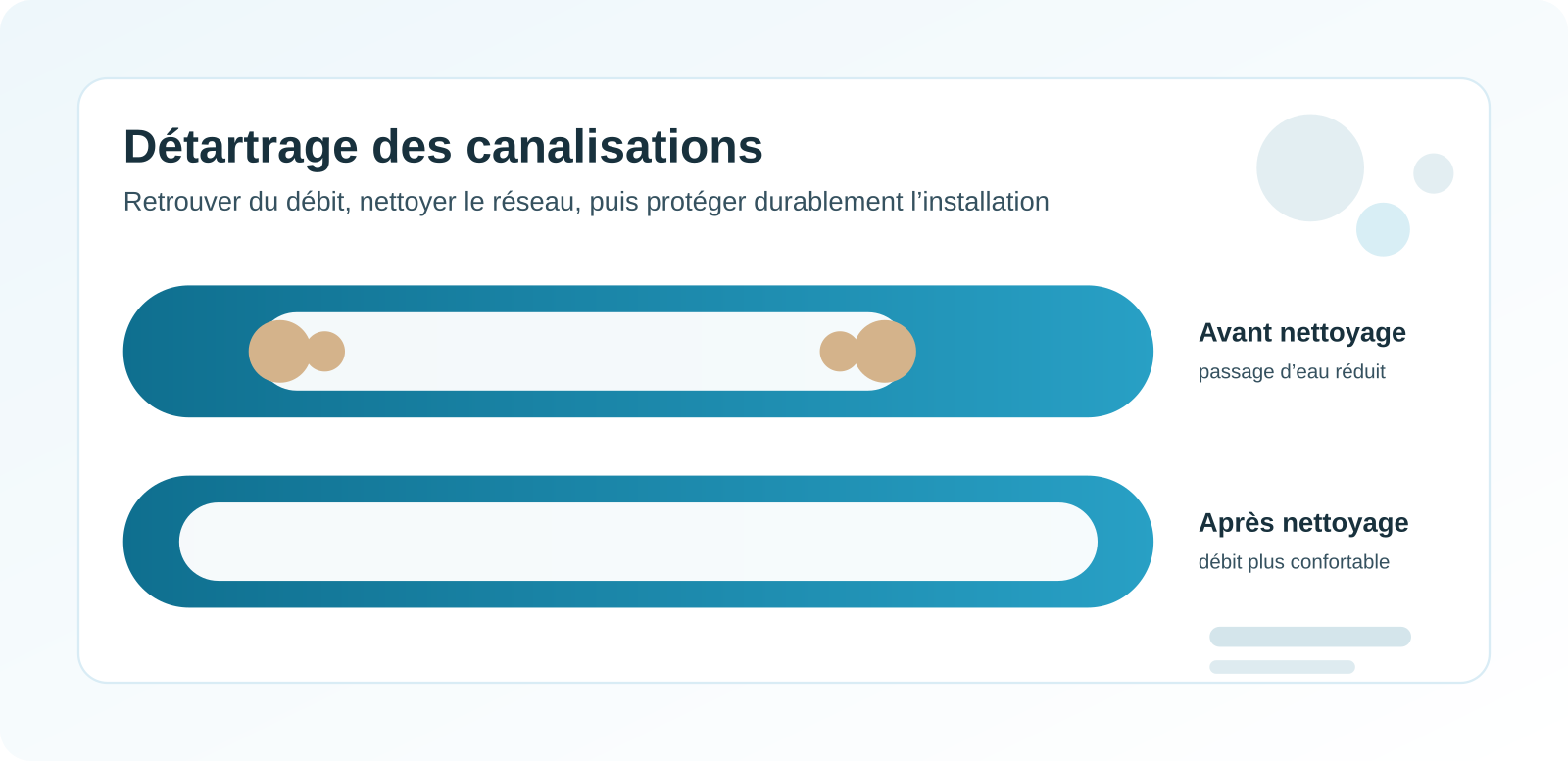
- Limescale isn’t just a cosmetic issue: it can restrict water flow, cause wear and tear on equipment and make everyday use more difficult.
- An anti-limescale system primarily helps to limit the formation or build-up of deposits; filtration serves other purposes. The two functions are complementary, but they are not the same.
- When a property is already heavily affected by limescale, the best course of action is often to clean the relevant system before installing a long-term protection solution.
Contents
1. Why does limescale eventually clog up the pipes?
In homes supplied with hard water or water with a high calcium content, some of the minerals gradually build up on the surfaces of the plumbing system, particularly when the water is heated. This phenomenon primarily affects domestic hot water, heating elements, storage tanks, heat exchangers and the most frequently used taps.
At first, limescale build-up is mainly visible on taps, shower screens, aerators, glasses and jugs. Then, over the years, the problem becomes less visible but more problematic: the effective diameter of the pipes decreases, water outlets become less user-friendly and certain appliances operate less efficiently.
This explains why a property can seem ‘normal’ for a long time, then suddenly start showing several signs at once: reduced water pressure, erratic hot water, the need for more frequent cleaning, limescale that returns quickly, and a general feeling that the system is ‘clogged up’.
2. Signs that a property may need descaling
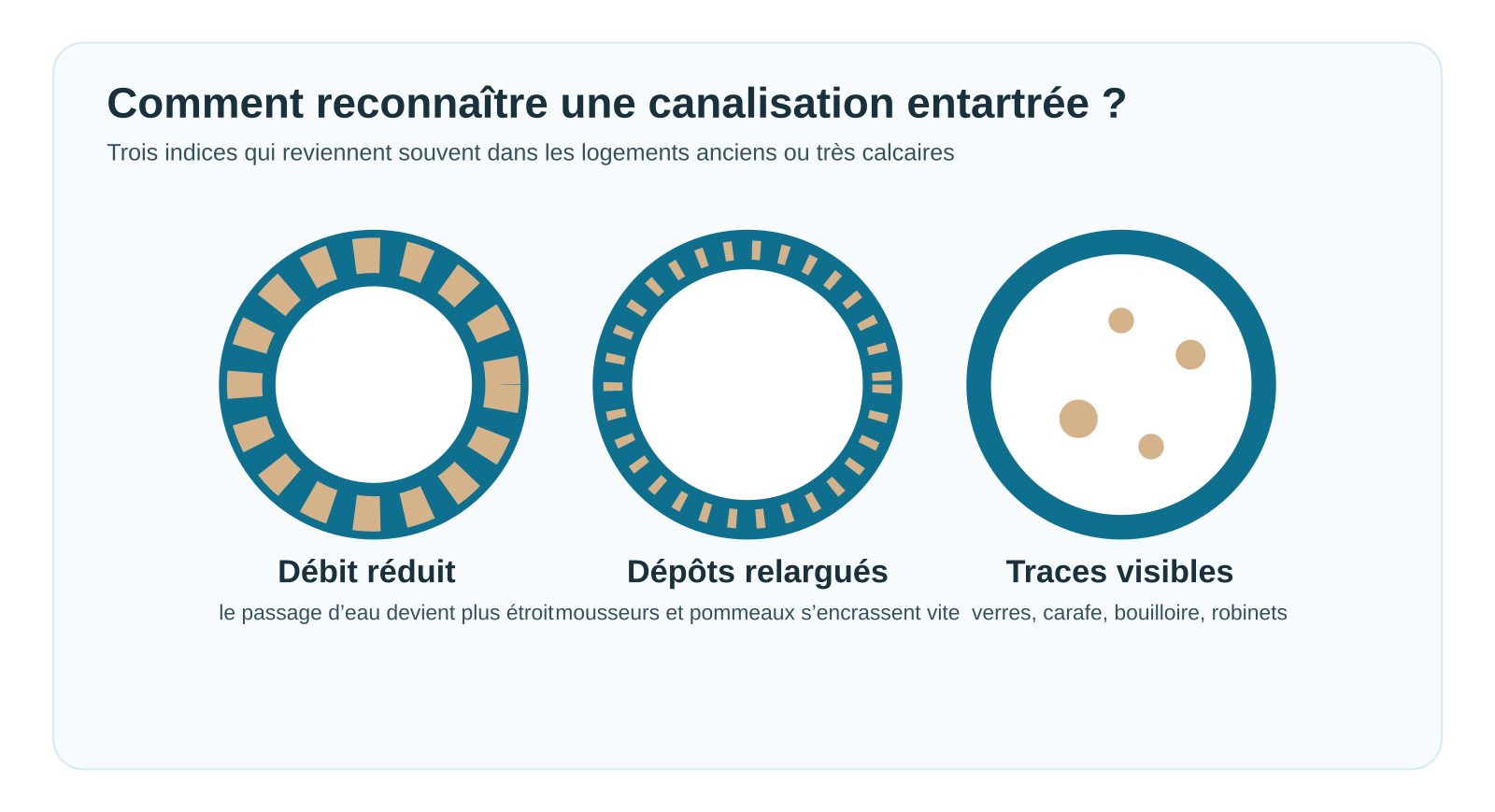
Not all limescale deposits require a full descaling. However, there are several warning signs to look out for if they build up over time.
| Symptom observed | What this might reveal | Level of attention |
|---|---|---|
| The water flow is weaker than before | Gradual narrowing of the passage in certain sections | Élevé |
| Aerators, shower heads or hoses that often get clogged | Release of sediments and circulation of highly turbid water | Medium to high |
| Longer waiting time to achieve a comfortable flow rate | Increased pressure drops in the system or the hot water production unit | Élevé |
| Frequent white deposits in glasses, the jug and the kettle | Highly mineralised water and recurring limescale build-up | One to watch |
| Recurring faults with the water heater, heat exchanger and taps | Mechanical consequences of long-standing limescale build-up | Very high |
The longer these symptoms have been present, the more one should focus on treatment rather than mere prevention.
The most useful signal
When a customer says both “my water flow has decreased” and “I can see a lot of limescale deposits”, they are rarely simply referring to surface maintenance: it is necessary to consider the possibility of limescale build-up inside the plumbing system or the fixtures.
3. Why a limescale inhibitor fitted at a late stage is not always enough
This is a key point for keeping readers properly informed: fitting a limescale inhibitor from the outset is an excellent preventive measure, but that does not mean it can, on its own, immediately restore a system that is already heavily clogged.
When limescale build-up is long-standing and significant, deposits are already present in certain parts of the plumbing system, around taps and fittings, in areas where water is heated, or where pressure drops are already severe. In this case, an anti-scale treatment can help to prevent the problem from getting worse and better protect the system in the future, without, however, removing several years’ worth of limescale in just a few days.
In other words, early prevention is a sound strategy, but rectifying a significant backlog sometimes requires a proper, targeted clean-up operation.
4. When should you consider a proper dental scaling?
Descaling becomes necessary when the problem is no longer merely aesthetic but also functional: a persistent reduction in water flow, issues with hot water, taps that regularly become blocked, sensitive appliances that quickly become limescale-encrusted, or an older plumbing system in an area with very hard water.
In the most severe cases, a professional may also conclude that replacing certain sections would be more appropriate than intensive descaling. The right approach is therefore not to “force” a treatment, but to choose the most sensible solution for the system’s lifespan.
5. The most thorough cleaning method for a network that is already under heavy load
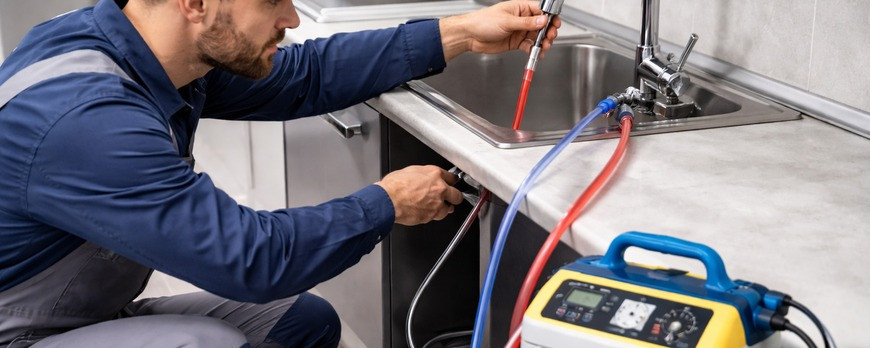
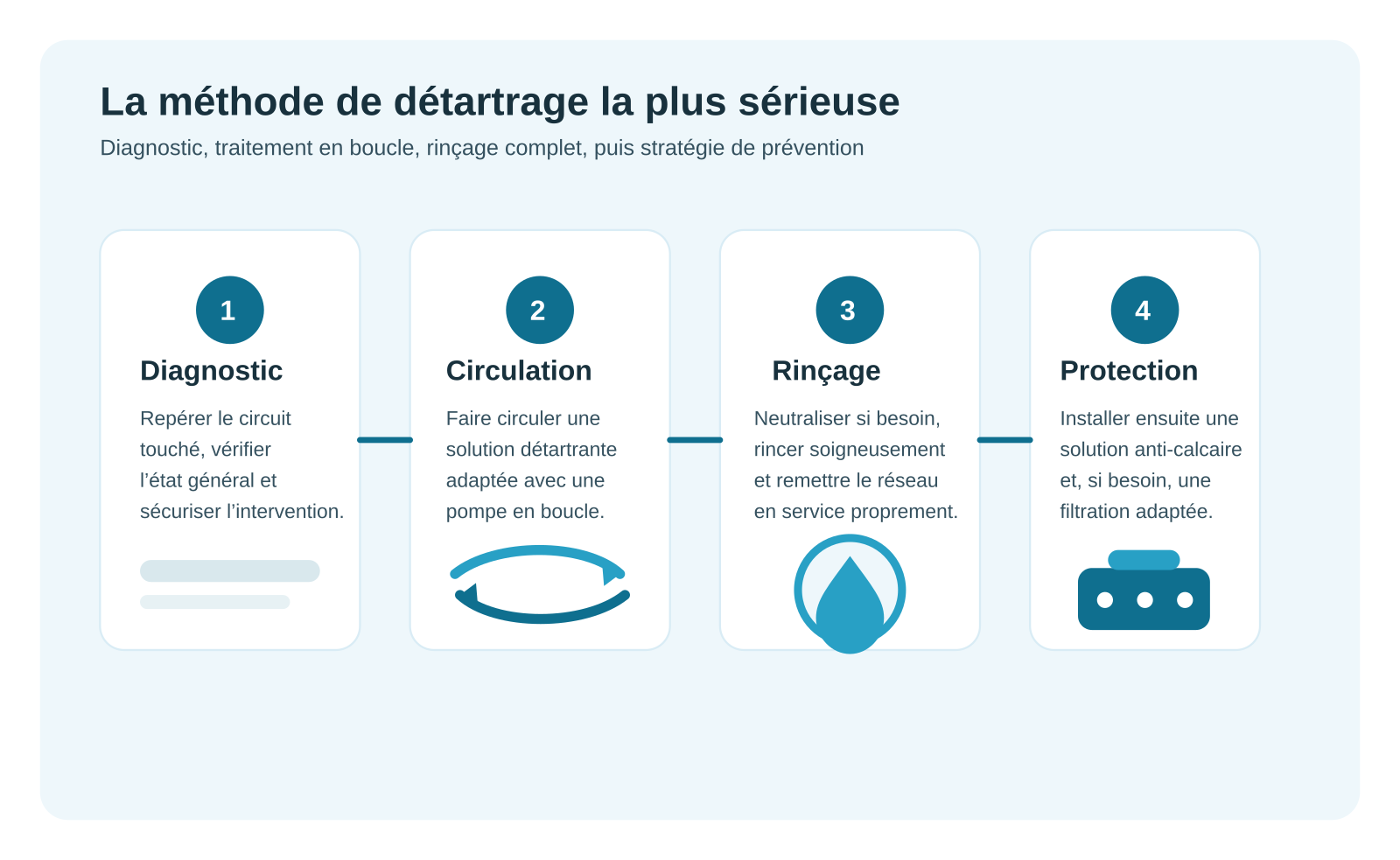
Descaling water supply pipes is nothing like simply unblocking a drain. Here, we are working on a plumbing system and the method must be thorough. In practice, professional interventions generally involve circulating a suitable descaling solution in a loop, with monitoring of the system, thorough rinsing and safe recommissioning.
Step 1: System diagnosis
Before carrying out any work, you must identify the relevant system: hot water only, the specific section, the cylinder, the heat exchanger, the manifold, and the taps most affected. This is also the time to check that the symptoms are consistent, assess accessibility, note the type of materials used, and evaluate the general condition of the system.
Step 2: Isolating and securing the circuit
The circuit to be treated is isolated, the valves are checked, and the overall integrity of the system is verified. This stage is essential: it helps to prevent operational errors and ensures that the system being worked on is suitable for the operation.
Step 3: Circulating a suitable descaling solution
The core of the method involves circulating a solution—formulated to dissolve limescale deposits whilst remaining suitable for the materials in the system being treated—in a closed loop using a descaling pump. Depending on the circumstances, the professional can adjust the concentration, duration, direction of flow and the actual area being treated.
In heavily loaded systems, flow control and intermediate rinsing of dislodged deposits can make a real difference. The aim is not simply to “run any product through the system”, but to achieve effective, controlled cleaning that is compatible with the system.
Step 4: Neutralisation, rinsing and recommissioning
Once the limescale has been dissolved, the system is thoroughly rinsed, then neutralised if required by the procedure. This step is crucial: effective descaling does not end with the dissolution of the deposits; it also involves restoring the system to clean and stable operation.
Step 5: Reviewing the results and prevention strategy
Once the system has been put back into service, we check that comfort has been restored, that the flow rate is stable, and that the water is of a satisfactory quality. It is only at this point that it becomes appropriate to discuss long-term protection: limescale protection, pre-filtration, activated carbon or a complete package, depending on the desired outcome.
The correct sequence of actions
Diagnose → clean → protect. This is the sequence that makes the most sense to readers and is the most commercially credible: it avoids presenting prevention as though it were an immediate cure.
6. Mistakes to avoid at all costs
- Confusing drainage with supply: cleaning a sewer pipe does not address a limescale-clogged drainage system.
- Pouring a “homemade” acid into the plumbing system without following the proper procedure: this is risky, imprecise and potentially damaging to materials, seals and the safety of the occupants.
- Promising a complete reset in all cases: on an old, heavily loaded or compromised network, a reset can significantly improve the situation without resolving everything 100%.
- Neglecting post-treatment care: cleaning without taking protective measures often means the problem will return.
7. After a dental scale and polish: how to prevent the problem from returning
Once the system has been restored to working order, the objective becomes clear: to slow down the re-formation of limescale deposits as much as possible and to protect the most sensitive equipment. This is where installing an anti-limescale solution really comes into its own.
To remain consistent with a modern approach to water treatment, it is important to bear two things in mind: an anti-scale agent helps manage limescale and protect the system; filtration targets other parameters depending on the cartridges or technologies used.
In many homes, the smartest solution is to combine salt-free limescale protection with pre-filtration, or even additional treatment of drinking water where this is what the household actually needs.
Need reliable advice on your installation?
If your home already shows signs of limescale build-up, the best approach is not to choose a product “at random”, but to first decide whether you’re looking to prevent or treat the problem.
8. Why combine limescale prevention and filtration in a home
Many buyers still confuse the two. However, they do not offer the same benefits: the primary purpose of anti-scale systems is to limit the effects of limescale in the plumbing system and on appliances; filtration, on the other hand, serves to trap certain particles or improve other aspects of user comfort, depending on the technology chosen.
It is precisely this distinction that makes an article stronger from both an SEO and a commercial perspective: the reader understands that they are not being sold a “one-size-fits-all solution”, but a tailored response to the actual problem they are facing in their home.
9. Descaling pipes: the best long-term strategy
The best approach isn’t to choose between descaling, anti-limescale treatment or a filter as if you absolutely had to pick just one. The right question is:
“Is the network still capable of providing protection, or is it already so overloaded that it requires a clean-up?”
When the answer is clear, so is the strategy:
- Network still healthy: we protect it early and effectively.
- Pipes already clogged with limescale: first we clear them, then we provide long-lasting protection.
It is this approach that offers the greatest value to the reader… and lends the most weight to your expertise.
FAQ – Descaling pipes in a home
Is a limescale inhibitor enough to clean a system that is already scaled up?
Not always. When a property has already built up a significant amount of limescale, prevention alone is not necessarily enough to immediately restore the lost water flow. It is sometimes necessary to start by descaling the affected plumbing system.
What are the most obvious signs of a limescale-clogged pipe?
A drop in water pressure, blocked aerators, recurring limescale deposits, less comfortable hot water, or repeated breakdowns of appliances are the most common signs.
What does a professional teeth cleaning involve?
Generally speaking, the technician isolates the circuit, checks the system, circulates a suitable descaling solution using a pump, then rinses the system and puts it back into service before recommending a protective solution.
Does descaling mainly apply to hot water?
Very often, yes. Areas where water is heated are particularly prone to limescale build-up: the hot water tank, heat exchanger, heating element and domestic hot water system.
Should filtration and limescale prevention be combined?
Very often, yes, but not for the same reason. The anti-scale system deals with limescale; filtration serves other purposes relating to comfort or performance, depending on the technology chosen.
Can you perform this type of procedure yourself?
It is easy to maintain an aerator, a shower head or a detachable unit. However, descaling an entire domestic water supply system requires a proper procedure, suitable equipment, and precautions regarding compatibility and safety.
Conclusion
Limescale isn’t just limited to visible white marks. Over several years, it can reduce user comfort, wear out equipment and reduce water flow in the home.
The most sensible approach, therefore, is not to promise a single miracle solution. The right approach is to distinguish between prevention and treatment: if the system is still in good working order, we take early preventive measures; if it is already clogged up, we clean it first, then put in place long-term protection.
It is precisely this approach that allows us to tackle the subject seriously, reassure the reader and turn the article into a genuine conversion page.
View our complete water treatment packagesRelated products
Leave a CommentLeave a Reply
Blog archives
Blog categories
Latest Comments

BIOPUR habitat
on How to get rid of the limestone !!!
BIOPUR habitat
on Water Softener and Limescale Remover Part 3,...
BIOPUR habitat
on Which water flow rate depends on the pipe diameter
BIOPUR habitat
on Water softener or anti-limescale filter: what...






 English
  Français
  Deutsch
  Italiano
  Español
  Belgium