
No products
Prices are tax included
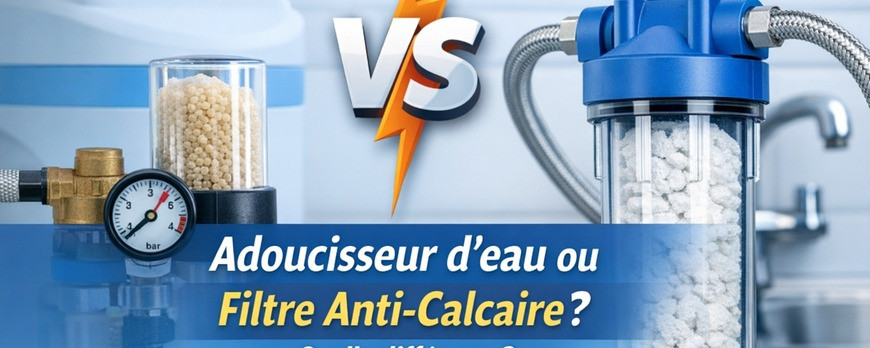
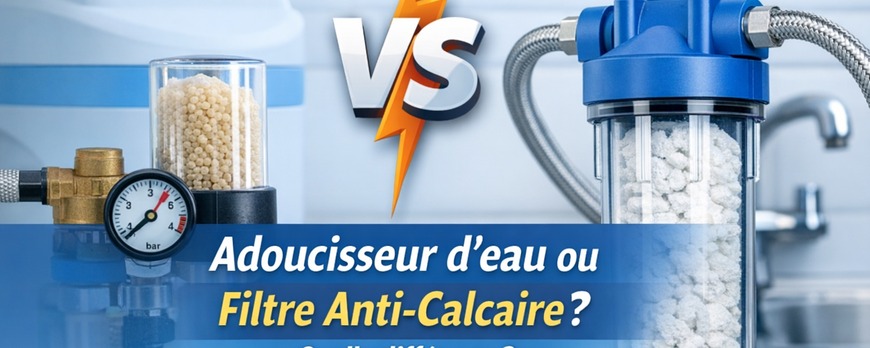
Water softener or anti-limescale filter: what is the difference and which solution should you choose?
The real risk when looking for a solution to limescale isn’t just hesitating between two products. It’s mainly choosing a system that doesn’t meet your actual needs. Many households do indeed compare salt-based water softeners, limescale filters, pre-filtration and purification as if they were equivalent solutions.
To make the right choice, you need to distinguish between what is used to reduce water hardness, what is used to protect the plumbing system, what is used to limit the effects of limescale and what is used to improve drinking water. Once you understand this difference, the choice becomes much simpler… and much more appropriate for your home.
What to avoid Buying an appliance “just because it claims to be limescale-resistant” without checking whether it actually meets your needs. | What you need to understand The water softener and the salt-free limescale inhibitor do not operate on the same principle nor are they subject to the same constraints. | That’s reassuring A well-designed system can combine filtration, scale control and drinking water. |
Key points in 30 seconds
- A salt water softener acts directly on the hardness of the water.
- A salt-free limescale filter is primarily designed to minimise the effects of limescale on the system.
- A sediment filter cartridge primarily protects against physical impurities.
- A water purifier improves the quality of the water at the tap.
Which solution best suits your needs?
You should opt for a salt-based water softener.
You should opt for a salt-free limescale inhibitor.
Start with a sediment pre-filter.
Add a water purifier to your tap.
Contents
1. What exactly is limescale in water?
Water described as “hard” is water rich in calcium and magnesium. It is these minerals that subsequently contribute to the formation of limescale, particularly when the water is heated.
This clarification is essential, as it explains why one does not choose in the same way a solution designed to reduce water hardness, a solution designed to protect pipes and a solution designed to improve drinking water.
What to look out for before buying
Don’t start by looking for “the best device”. Start by looking for the right feature for your actual needs.
2. The actual role of a filter cartridge
A sediment filter cartridge traps physical impurities: sand, silt, rust, suspended solids or small particles present in the water system. It therefore provides valuable protection for plumbing and appliances.
However, it does not serve the same purpose as a water softener or a salt-free limescale inhibitor. It is often the first component in a comprehensive system, rather than a standalone solution.
See also: water filters for the home.
3. How does a salt-based water softener work?
The salt water softener works by ion exchange. It acts directly on the water’s hardness by replacing some of the calcium and magnesium with sodium.
Its advantage is clear: it is specifically designed to tackle hard water. On the other hand, it also involves greater demands: salt, regeneration, maintenance, space requirements and system monitoring.
It is a viable solution, but it is not necessarily the best option for every household. It all depends on the water hardness, sensitivity to salt, the level of maintenance required, and the level of comfort sought.
4. How does a salt-free limescale filter work?
The term limescale filter covers a number of different approaches. Their aim is not necessarily to remove all dissolved minerals, but rather to limit the formation, build-up or effects of limescale within the system.
This makes it an attractive option for households looking for a salt-free solution that requires less maintenance and is more focused on protecting the home and ensuring user comfort.
| Comparison | Salt water softener | Filter / salt-free limescale inhibitor |
|---|---|---|
| Main action | Reduces water hardness | Above all, it helps to reduce the effects of limescale |
| Interview | More restrictive | Often simpler |
| Water composition | Amended | Usually retained |
| Ideal profile | Foyer seeking a direct impact on hardness | A household looking for a salt-free alternative that prioritises comfort |
Useful guides: electrostatic limescale inhibitors, magnetic limescale inhibitors, electronic limescale inhibitors.
5. Which solution should you choose based on your needs?
Are you mainly looking to reduce the hardness?
The salt-based water softener is the simplest solution.
Do you want to reduce limescale without using salt?
A salt-free limescale inhibitor is often more suitable.
You want to protect the equipment first
Install a sediment pre-filter.
Are you looking for a simpler, all-in-one solution?
A complete package combining filtration, limescale prevention and drinking water may be the most convenient option.
Want to avoid making a mistake?
The simplest approach is to start by identifying your actual needs, and then work towards the solution that best suits your home, the level of limescale in your water and your daily usage.
6. Why a combined strategy is often the best
In many homes, the best solution is not a single device marketed as a “miracle solution”. It is a logical combination of several complementary functions.
- pre-filter to protect the equipment;
- managing limescale to minimise its effects in the home;
- improving drinking water where it is actually consumed.
Products that meet a specific need
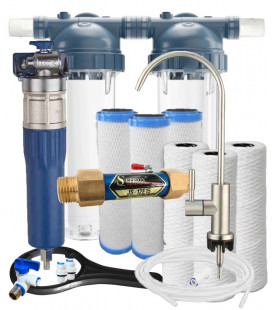
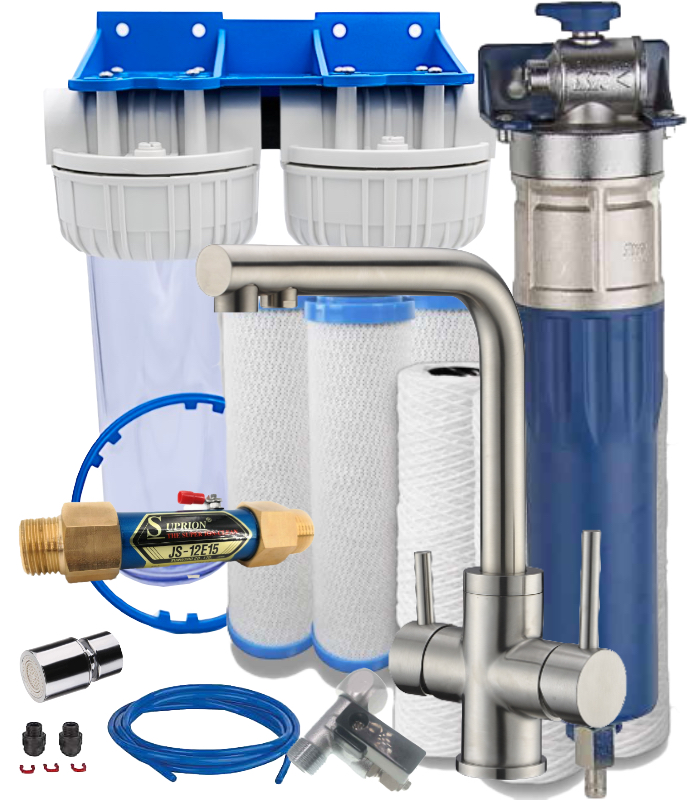
- For a simple, all-in-one solution: Suprion JS 12e15 limescale protection pack and water filter
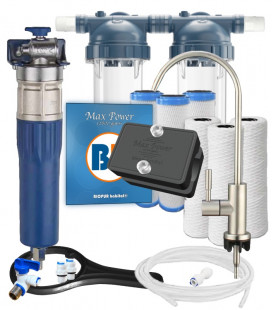
- For salt-free protection: Max Power 12800 Magnetic Pack + water purifier + water filter
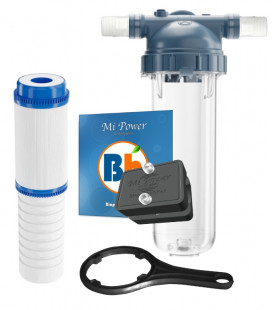
- For a more economical solution: Mi Power magnetic limescale prevention kit with water filter
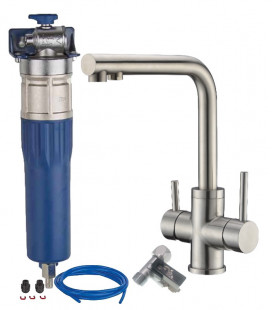
- To improve the quality of tap water: Water purifier with a 3-way tap
7. FAQ – The questions that most often put people off buying
Does a limescale filter replace a water softener?
Not exactly. A water softener tackles hardness directly; a salt-free limescale inhibitor mainly tackles the effects of limescale. The choice therefore depends on your actual needs.
Which solution requires the least maintenance?
Generally speaking, a salt-free limescale prevention system is often easier to use than a salt-based water softener, although this depends on the model and the installation.
Can you combine a limescale inhibitor with a water purifier?
Yes, and that’s often a very good approach: one protects the system, whilst the other improves the quality of the water actually consumed on a daily basis.
How do I know if I should start with pre-filtration?
If you are looking to protect your equipment from impurities in the mains water supply, pre-filtration is often the logical first step before installing a limescale treatment system or a water purifier.
Conclusion
The right choice isn’t about asking whether a water softener is “better” than a limescale filter. It’s about identifying what you want to treat as a priority: hardness, the effects of limescale, impurities or drinking water.
Want to make the right choice?
Simply describe your home and your requirements: you can then choose the most suitable solution, without over-specifying or making a bad purchase.
Get personalised adviceRelated products
Leave a CommentLeave a Reply
Blog archives
Blog categories
Latest Comments

BIOPUR habitat
on How to get rid of the limestone !!!
BIOPUR habitat
on Water Softener and Limescale Remover Part 3,...
BIOPUR habitat
on Which water flow rate depends on the pipe diameter
BIOPUR habitat
on Water softener or anti-limescale filter: what...







 English
  Français
  Deutsch
  Italiano
  Español
  Belgium
2 Comments
BIOPUR habitat 2026-07-08 Reply
Bonjour, le plus simple est de nous contacter directement par la messagerie du site Internet, on vous demandera plus de détails sur votre projet pour bien pouvoir vous orienter.POUMEYROL 2026-01-13 Reply
Bonjour Tres interessant votre infoPouvez vous me conseiller l'install ideale pour une maison sans le sud abritant 6 mois sur 12 , 2 personnes avec pas mal d'invités
D'autre part , pour une copro de 50 appart sur Paris que peut on faire
A vous lire