
Cart 0
0 item(s) - 0,00 € No products
To be determined Shipping
0,00 € Of which taxes of
0,00 € Total incl. taxes
Prices are tax included
Quantity
Total incl. taxes
Product successfully added to your shopping cart
There are 0 items in your cart. There are 0 items in your cart.
Total incl. taxes (tax incl.)
How to choose the right water filter cartridge
Sediment, activated carbon block, granular activated carbon, mixed-media or specialist treatment cartridges: not all filter cartridges perform the same function. The right choice depends on the quality of the water, what you want to treat, the required flow rate, the cartridge size and its position in the system.

Key point
A cartridge should not be selected solely on the basis of its micron rating. Its function, size, required flow rate and position in the installation must also be considered. In a multi-stage filtration system, the more technical media are generally protected by an upstream sediment filtration stage.
How does a water filter cartridge work?
The technologies can be very different, but the principle is always the same: identify what you want to improve in the water, then choose a cartridge containing a medium capable of performing that function.
1
A need is identified
The water has a characteristic that needs to be improved.
→
2
A suitable cartridge
The cartridge contains a medium selected for that function.
→
3
The medium acts
Water passes through the medium, which acts according to its operating principle.
→
4
The result is achieved
The targeted parameter is reduced or modified depending on the cartridge used.
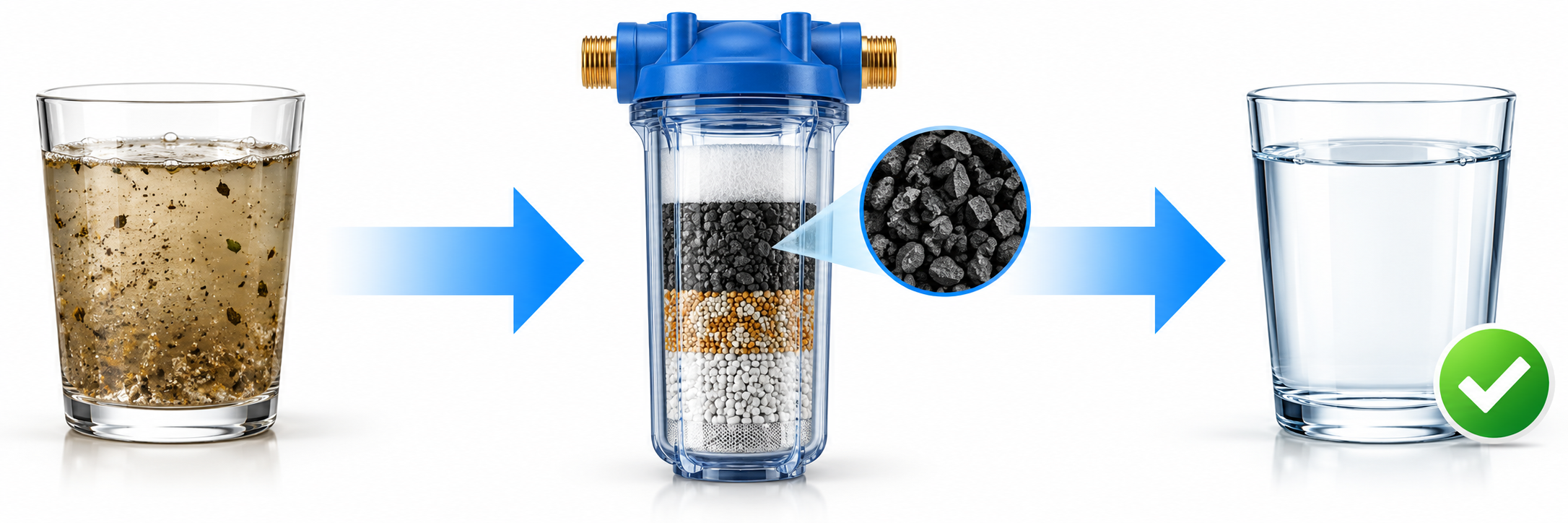
Identified need → cartridge with suitable media → action of the media → desired result
What does the micron rating of a cartridge mean?
The lower the micron rating, the finer the particle filtration can be
One micron is one thousandth of a millimetre. A 5 micron sediment cartridge is therefore designed to retain finer particles than a 10, 15 or 20 micron cartridge.
However, the lowest possible micron rating should not always be selected. A very fine cartridge can clog more quickly and create greater pressure loss, particularly when filtering water for an entire home.
With an activated carbon block cartridge, the micron rating should not be interpreted solely as a level of mechanical filtration. The block structure also affects water flow through the carbon, contact time with the media and pressure loss.
Why use a 10 µm activated carbon block after a 5 µm sediment cartridge?
At first sight this may seem illogical: the water first passes through a 5 micron sediment cartridge, then through a 10 micron activated carbon block.
However, they perform different functions. The 5 µm sediment cartridge has already carried out the fine mechanical filtration of particles.
Activated carbon is mainly used for its adsorption action. Its structure forces the water through the block, increases contact time with the carbon and can therefore slow the water more than a simple sediment cartridge. The micron rating does not therefore always refer solely to the size of particles that need to be retained.
What sizes of filter cartridge are available?
9 3/4 inch and 10 inch domestic cartridge sizes
In domestic filtration, 9 3/4 inch and 10 inch cartridges are the most common sizes. The dimensions shown here refer to cartridge length.
9 3/4 inch: approximately 248 mm long
10 inch: approximately 254 mm long
10 inch: approximately 254 mm long
The difference is only about 6 mm, but it can be important. A 9 3/4 inch cartridge can be used in many housings designed for 10 inch cartridges.
Warning: the reverse is generally not possible. A housing specifically designed for 9 3/4 inch cartridges may not have enough height for a true 10 inch cartridge. The cartridge may be too long and prevent the housing from closing correctly. This is particularly relevant in France and Belgium, where many 9 3/4 inch filter housings are still in use.
Check compatibility in the correct direction
In many housings intended for 10 inch cartridges, a 9 3/4 inch cartridge can be fitted directly. Where a few extra millimetres of support are required, a compatible flat gasket can sometimes be added to compensate for the difference in length.
This gasket can sometimes be reused from the old cartridge if it is clean, in good condition and suitable for the assembly.
A 10 inch cartridge must never be forced into a housing designed specifically for 9 3/4 inch. If it is too long, never force the bowl closed.
What about 20 inch and Big Blue cartridges?
20 inch cartridges are approximately 508 mm long. Their greater size allows more filter media or surface area and is suitable for installations requiring greater capacity or flow.
Big Blue refers to a larger cartridge diameter, not to a cartridge length. Big Blue cartridges are available in both 10 inch and 20 inch lengths.
20 inch and Big Blue formats are more commonly used in large homes, collective, professional or industrial installations. For a typical domestic installation, 9 3/4 and 10 inch formats remain the most common.
Main cartridge sizes at a glance
| Size | Length / feature | Typical use |
|---|---|---|
| 9 3/4 inch | Approx. 248 mm | Very common domestic filtration |
| 10 inch | Approx. 254 mm | Common domestic filtration |
| 20 inch | Approx. 508 mm | Large systems, high flow rates and professional use |
| Big Blue | Larger diameter, notably available in 10" and 20" | High flow rates, large installations and professional use |
Our recommended configuration for whole-house water filtration
5 µm sediment cartridge + 10 µm activated carbon block
For whole-house domestic filtration, our standard recommendation is a 5 micron sediment cartridge followed by a 10 micron activated carbon block cartridge.
The sediment cartridge provides fine mechanical particle filtration, while the activated carbon acts mainly by adsorption on chlorine, tastes, odours and certain substances that can be retained by this medium.
10 or 15 micron sediment cartridges are commonly offered for domestic filtration. We favour 5 micron filtration, which provides finer filtration while retaining a suitable flow rate when the system is correctly sized.
This choice is also useful when a UV steriliser is installed downstream. Filtration of around 5 microns is commonly recommended before UV treatment to limit particles and turbidity that could interfere with UV transmission. The UV manufacturer's recommendations should always be followed.
For activated carbon, a 10 micron block provides a useful balance between adsorption efficiency, carbon contact time and water flow without creating unnecessary pressure loss.
In a correctly sized installation with suitable inlet pressure, this combination provides comfortable flow for a typical home and is generally suitable for a property with two to three bathrooms. Actual flow also depends on mains pressure, the filter housing used and the number of outlets used simultaneously.
Main types of filter cartridge
Mechanical filtration
Sediment cartridges: retaining particles
Sand, sludge, rust and suspended particles
A sediment cartridge primarily performs mechanical filtration. It retains particles present in the water and protects cartridges installed downstream.
Around 5 microns is a very good compromise for many domestic installations. Where the water contains a large amount of particles, a coarser upstream pre-filter can extend its service life and reduce clogging.
Adsorption
Activated carbon block cartridge
Carbon efficiency without unnecessarily sacrificing flow
Activated carbon is compacted into a block so that the water passes through the filtering medium. It can improve water taste and odour, reduce chlorine and act on certain substances adsorbable by activated carbon.
In whole-house filtration, the carbon block is not mainly selected to provide mechanical sediment filtration: that role has already been performed by the upstream 5 micron sediment cartridge.
Its structure forces water through the block and promotes contact with the activated carbon. A 10 micron block therefore offers a balance between contact time, adsorption efficiency, flow rate and pressure.
Additional adsorption
Granular activated carbon cartridge
An additional activated carbon stage
Granular activated carbon consists of carbon granules through which the water flows. It can be used alone in some configurations or as a complement to a carbon block to add another adsorption treatment stage.
Several functions
Mixed-media cartridge: several functions in one cartridge
Useful where space is limited
Some cartridges combine several filter media in one element, for example sediment filtration and activated carbon.
This allows several functions to be performed in one housing and can be particularly useful in compact installations or where only a limited number of filter housings can be fitted.
Specialist treatment cartridges
Some cartridges are designed to address a particular requirement: ion-exchange resins, specialist media or combinations of filtration materials.
They should be selected according to the actual problem identified in the water. For well, borehole or spring water, prior water analysis is particularly important before choosing specialist treatment.
In what order should the cartridges be installed?
Typical progressive filtration example
Water → optional pre-filtration → 5 µm sediment → 10 µm activated carbon block → granular carbon or specialist treatment
Why put sediment filtration first?
An upstream sediment cartridge retains particles that could prematurely clog activated carbon or more technical media. It therefore also protects the following stages.
Comparison of the main cartridge types
| Cartridge type | Main function | Typical position | Best suited to |
|---|---|---|---|
| Sediment | Retaining particles | Beginning of filtration | Sand, sludge, rust and suspended matter |
| Activated carbon block | Adsorption and complementary treatment | After sediment filtration | Taste, odours, chlorine and certain adsorbable substances |
| Granular activated carbon | Additional treatment by adsorption | After pre-filtration | Complementing activated carbon filtration |
| Mixed-media cartridge | Combining several functions | According to composition | Compact installations |
| Specialist treatment | Treating a specific need | According to treatment | Identified water issue or specialist use |
Flow rate and pressure loss
A very fine or heavily loaded cartridge can reduce flow more than a coarser filtration stage. Whole-house filtration must therefore take account of required flow rate, available pressure, filter housing size and cartridge clogging. A gradual drop in pressure can also indicate that a cartridge needs replacing.
How often should filter cartridges be replaced?
Up to around one year under good conditions, depending on the cartridge
In a typical domestic installation, some cartridges can be used for up to approximately one year when water quality and operating conditions allow. The cartridge manufacturer's replacement interval should nevertheless always be followed.
This period is not fixed. It depends directly on water quality, water consumption, cartridge type and the amount of material it must retain.
For example, water containing a large amount of iron will saturate an iron-reduction cartridge more quickly. The greater the concentration and the amount of water treated, the shorter its useful life may be.
The same applies to a sediment cartridge. Work on the mains, pipe interventions or a sudden influx of sludge, sand or rust can load the cartridge very quickly.
Do not rely solely on the calendar. Reduced flow or pressure, visible clogging or an unusual change in filtered water may indicate that replacement is required earlier.
Tips for opening and reassembling a filter housing
Two important precautions when changing cartridges
1. Tighten the bowl by hand, without forcing it
After replacing the cartridge, the bowl should generally be tightened by hand. The O-ring provides the seal.
The supplied wrench is mainly intended to loosen the bowl. Excessive tightening can unnecessarily compress the O-ring and make the next service more difficult.
2. Always release the pressure before unscrewing the bowl
Before opening the filter housing, shut off the water supply and release the pressure.
If the housing has a pressure-release valve or button, operate it after closing the water supply.
Without a pressure-release valve, normally open a downstream tap until pressure has been released. A pressurised bowl can be extremely difficult, or even impossible, to unscrew.
Mains water or rainwater, borehole and well water: the same cartridge?
Mains water
With already potable mains water, the aim is often to retain any particles and improve certain characteristics of the water using activated carbon.
Rainwater, spring, borehole or well water
The choice must be much more personalised. Particle type, turbidity, iron, manganese and microbiological or chemical parameters should be considered before defining the treatment chain.
Discover our water filter cartridges
Sediment cartridges, activated carbon and treatment solutions: choose your cartridges according to the required filtration and your installation.
View water filter cartridges → Frequently asked questions
Which cartridge should be installed first?
In a typical installation, the sediment cartridge is generally installed before activated carbon to retain particles and protect downstream filter media.
Why choose a 5 micron sediment cartridge?
A 5 micron rating retains finer particles than the 10 or 15 micron cartridges commonly used for domestic filtration. It remains suitable for a correctly sized system and is particularly useful when UV sterilisation is installed downstream, subject to the UV manufacturer's recommendations.
Why use a 10 micron activated carbon block?
Fine mechanical filtration is already provided by the 5 micron sediment cartridge. The 10 micron carbon block is therefore selected primarily to achieve a good balance between carbon contact, adsorption efficiency, flow and pressure loss.
Are 9 3/4 and 10 inch cartridges interchangeable?
Not always. A 9 3/4 inch cartridge can be fitted in many 10 inch housings, sometimes with an additional flat gasket. A genuine 10 inch cartridge, however, is often too long for a 9 3/4 inch housing.
How often should a filter cartridge be replaced?
Depending on cartridge type and manufacturer recommendations, some domestic cartridges can be used for up to around one year under good conditions. Heavily loaded water, mains works or reduced flow or pressure may require earlier replacement.
Why is my filter housing difficult to unscrew?
Check that the water supply is closed and all pressure has been released using the pressure-release valve or a downstream tap. Residual pressure can make removal extremely difficult.
What is the difference between activated carbon block and granular carbon?
Carbon block is compacted so that water passes through its structure, while granular activated carbon consists of loose granules. The two technologies can be used separately or together.
Does an activated carbon cartridge remove limescale?
No. Activated carbon does not treat the hardness responsible for limescale. A dedicated anti-limescale treatment must be added when limescale reduction is required.








 English
  Français
  Deutsch
  Italiano
  Español
  Belgium