Practical guide Reading time ~9 min
How to filter rainwater, borehole, well or spring water?
Water from a non-mains source cannot be treated with a single device. The most effective approach is to work in stages: protect the installation, remove particles, treat specific water-quality issues, then make the water suitable for its intended use.
First step
Analyse the water
Well, borehole and spring water can contain substances that cannot be seen with the naked eye. A water analysis helps identify the treatments that are actually required.
Principle
Filter progressively
Remove the largest particles first, then use finer filtration, activated carbon and specific treatment stages according to the actual water quality.
Final stage
UV at the end of the treatment line
When UV disinfection is required, it is installed after the different filtration stages, once the water is sufficiently clear.
Rainwater, well, borehole or spring water: what are the differences?
Before choosing the equipment, the first step is to identify the source of the water. Each source has different characteristics and may require a specific treatment process.
Rainwater
It may contain dust, pollen, particles from the roof, organic matter and various impurities related to storage.
Well water
Often drawn from a relatively shallow aquifer, its quality may vary according to the season, rainfall, soil type and the surrounding environment.
Borehole water
Usually drawn from greater depth, it may contain iron, manganese, limescale, fine sand or other dissolved substances.
Spring water
Its natural appearance does not guarantee its sanitary quality. Its composition may vary and should be known before the appropriate treatment is selected.
Clear water is not necessarily water that can be used without precautions
Some bacteria and dissolved substances are invisible to the naked eye. For well, borehole or spring water, and more generally whenever the water will be used for sensitive purposes, an analysis is essential to determine the appropriate treatment.
The required level of treatment also depends on how the water will be used
Water used only for garden irrigation does not require the same precautions as water used inside the home. The more sensitive the intended use, the more important water-quality monitoring and reliable treatment become.
| Use | Priority | Approach |
|---|
| Irrigation / outdoor use | Protect the pump and installation | Suitable intake strainer and pre-filtration according to water quality |
| Toilets / technical uses | Reliability and cleanliness of the system | Pump, pressure system and suitable filtration |
| Sanitary uses | Microbiological quality | Analysis, complete filtration and appropriate treatment |
| Drinking / cooking | Highest requirements | Analysis, compliant installation and treatment sized to the water quality |
Important: keep water networks separate
An installation using non-mains water must be designed to prevent any unwanted backflow or connection with the public mains water network. The installation and intended uses must comply with the regulations applicable to the site concerned.
Before the filters: intake strainer, pump and booster system
Filtration is only one part of the installation. The water must first be collected, pumped and supplied at sufficient pressure to feed the different treatment units correctly.
Intake strainer
Stops the largest debris and protects the pump intake.
Non-return valve
Prevents water from flowing backwards and helps keep the system primed.
Pump
A surface pump draws the water in, while a submersible pump pushes it up from the well or borehole.
Booster system
Stabilises the pressure, reduces repeated pump starts and improves everyday comfort.
Avoid filtration that is too fine before the pump
A fine filter cartridge installed on the suction side can restrict the incoming water, make priming more difficult and cause the pump to operate under poor conditions. The main filtration stages are generally installed after the pump and booster system.
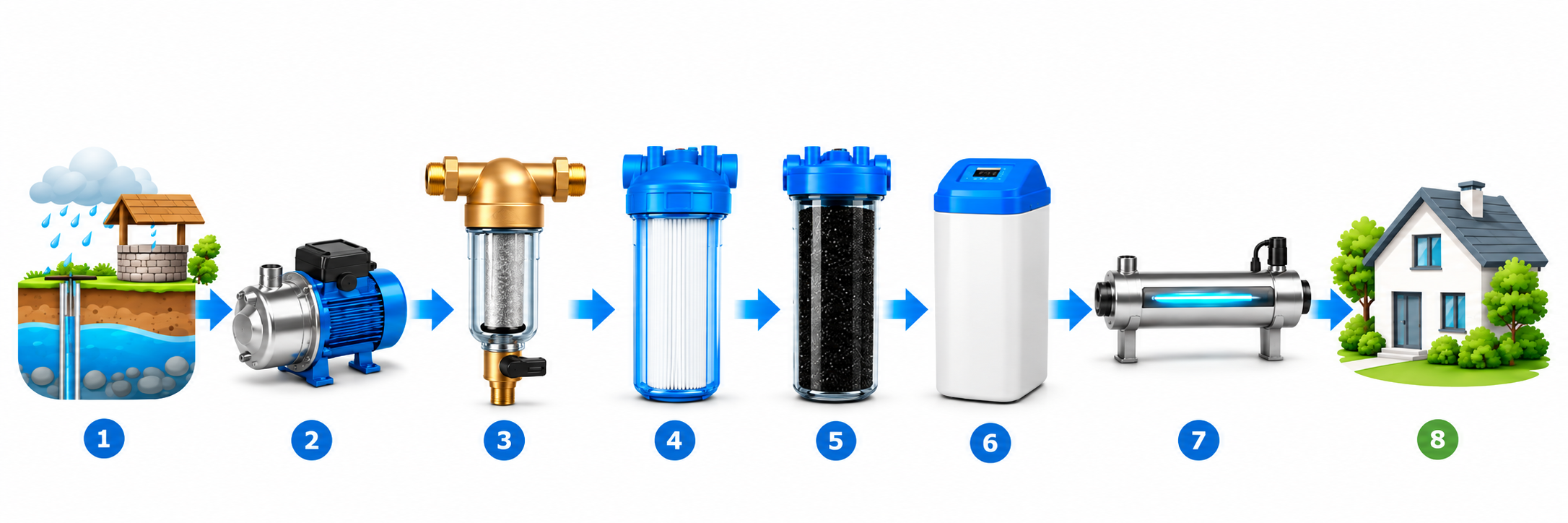
In what order should the water be filtered?
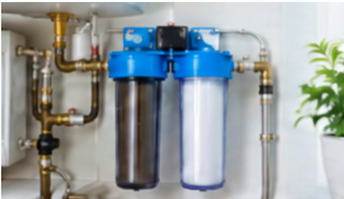
The basic principle is to work from coarse to fine filtration. Each stage protects the next and helps prevent premature cartridge clogging.
1
Rainwater /
well / borehole
3
Self-cleaning filter
40 µm
6
Anti-limescale
if required
!
If iron is present: provide suitable treatment before the UV sterilisation stage.
Water source → pump / booster system → self-cleaning filter 40 µm → sediment 5 µm → activated carbon → anti-limescale treatment if required → UV → distribution
Filtration stage 1
Self-cleaning pre-filter around 40 microns
It captures the coarsest particles: sand, sludge, small debris and suspended matter. Its relatively coarse filtration helps limit clogging and protects the cartridges installed downstream.
Filtration stage 2
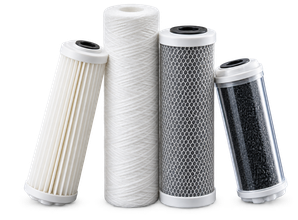
5-micron sediment filtration
This stage refines the filtration and captures smaller particles: fine sand, silt, rust and other suspended matter still present in the water.
Filtration stage 3
Activated carbon
Activated carbon is used after particle filtration. It can help improve the taste and odour of the water and act on certain substances depending on the filter medium used.
What should you do if the water contains iron?
Iron is relatively common in some well and borehole water. It may cause yellow or orange discolouration, reddish deposits on sanitary fittings or a metallic taste.
In this situation, a specific treatment stage should be added. Its position in the treatment line depends in particular on the technology used in the iron-removal cartridge.
Example of a treatment line when iron is present
Pre-filter ~40 µm → iron treatment → sediment 5 µm → activated carbon → anti-limescale treatment if required → UV
If the cartridges turn red very quickly
Water with a high iron content may exceed the capacity of a simple filter cartridge. A water analysis can then determine whether a dedicated iron-removal system is required.
What should you do if well or borehole water is hard?
Water from a private source may also be hard. Limescale can then build up in pipes, appliances and certain treatment equipment.
In an installation fitted with a UV steriliser, particular attention should be paid to the quartz sleeve: limescale deposits can reduce the transmission of ultraviolet light.
Hard water: treat limescale before the UV unit
When the water hardness makes it necessary, the anti-limescale treatment is installed after the filtration stages and before the UV steriliser.
Why should the UV steriliser be installed as the final stage?
UV treatment acts on microorganisms that are sensitive to UV-C radiation. It does not replace mechanical filtration and does not remove sand, iron, nitrates, heavy metals or limescale.
To work under good conditions, the UV unit must receive water that is sufficiently clear and properly pre-filtered. It is therefore installed at the end of the treatment line, after the necessary filtration and treatment stages.
Before the UV unit
Reduce turbidity and particles, treat iron when necessary and limit limescale deposits when the water is hard.
Maintenance
The UV lamp is a consumable component and the quartz sleeve must remain clean. Maintenance should follow the recommendations for the steriliser being used.
Why have the water analysed?
Water analysis is particularly important for well, borehole and spring water. Depending on the situation, it can be used to check turbidity, pH, hardness, iron, manganese, nitrates, conductivity and various microbiological parameters.
Without an analysis, it is possible to improve the appearance of the water while leaving an invisible problem untreated. The analysis therefore helps determine which equipment is actually required and the correct order in which it should be installed.
A suitable treatment line rather than a single device
The principle is to give each stage a specific role: protect the installation, pre-filter, refine the filtration, treat a specific problem, then disinfect when necessary.
Which solution should you choose?
Biopur Habitat offers several configurations that provide a coherent starting point and can then be adapted to the results of the water analysis and the required flow rate.
Expandable filtration
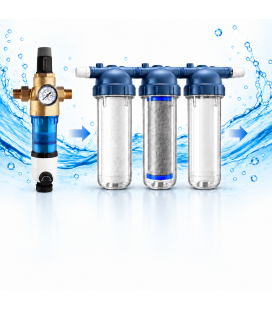
Pre-filter + triple filter
A complete mechanical filtration base with pre-filtration for larger particles followed by three housings that allow the cartridges to be adapted to the quality of your water.
Rainwater, Borehole, Well & Spring Water Filtration Pack – Self-Cleaning + Triple Filter
Voir le produit → Filtration + UV
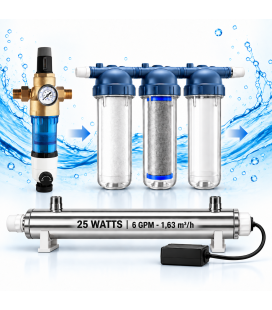
Pack with 25 W UV steriliser
Pre-filtration, triple filtration and UV treatment as the final stage to create a complete treatment line suitable for many domestic applications.
Rainwater, Borehole, Well & Spring Water Filtration Pack + 25 W UV Sterilizer
Voir le produit → Higher flow requirements
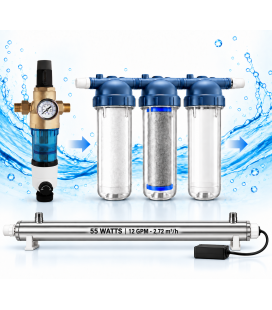
Pack with 55 W UV steriliser
A configuration based on the same treatment principle with a more powerful UV steriliser, designed for installations requiring a higher treatment flow rate.
High-Flow Rainwater, Borehole, Well & Spring Water Filtration Pack + 55 W UV
Voir le produit → The most common mistakes
Assuming that clear water is necessarily safe
Many undesirable substances do not necessarily alter the appearance of the water.
Installing only a UV unit
UV does not replace pre-filtration or the treatment stages required upstream.
Filtering too finely before the pump
This can restrict the water supply to the pump and interfere with its operation.
Ignoring iron
Iron-rich water can clog fine filter cartridges very quickly.
Forgetting limescale before the UV unit
A scaled quartz sleeve can reduce UV transmission.
Neglecting maintenance
The pre-filter, cartridges, UV lamp and quartz sleeve all require regular maintenance.
FAQ – Filtering rainwater, well, borehole or spring water
Can rainwater be drunk after filtration?
Filtration alone is not enough to consider rainwater safe for drinking. For any food or drinking-water use, the applicable regulations must be taken into account, the water should be analysed and the treatment adapted to the results.
Can well or borehole water be used inside the home?
This depends on the intended use and the actual quality of the water. A water analysis helps determine the necessary treatment. The installation must also prevent any risk of backflow or unwanted connection with the public mains supply.
Where should the self-cleaning filter be installed?
It is generally installed after the pump and the booster system. It captures the largest particles before the water reaches the finer filter cartridges.
Where should an iron-removal cartridge be installed?
Its position depends on the technology used. If the iron-removal cartridge also provides mechanical filtration, it can be installed after the coarse pre-filter and followed by a finer sediment cartridge. Water with a high iron content may require a dedicated iron-removal treatment system.
Why install activated carbon after sediment filtration?
Sediment filtration protects the activated carbon from particles that could clog it too quickly. The activated carbon can then work under better conditions to improve taste and odour and act on certain substances depending on the filter medium used.
Why treat limescale before the UV steriliser?
When the water is hard, deposits can build up on the quartz sleeve. A scaled quartz sleeve transmits ultraviolet radiation less effectively. An appropriate anti-limescale treatment can therefore be installed before the UV unit.
Is a UV steriliser alone enough to make water drinkable?
No. UV acts on microorganisms that are sensitive to ultraviolet radiation, but it does not remove particles, iron, nitrates, heavy metals or limescale. It must form part of an appropriate treatment line and does not replace a water analysis.
What should you do if the cartridges turn red or clog very quickly?
Red or orange discolouration may indicate a significant iron content. If the cartridges become saturated very quickly, a simple iron-removal cartridge may not be sufficient. It is then preferable to analyse the water and consider a suitable dedicated iron-removal treatment.











 English
  Français
  Deutsch
  Italiano
  Español
  Belgium