
No products
Prices are tax included
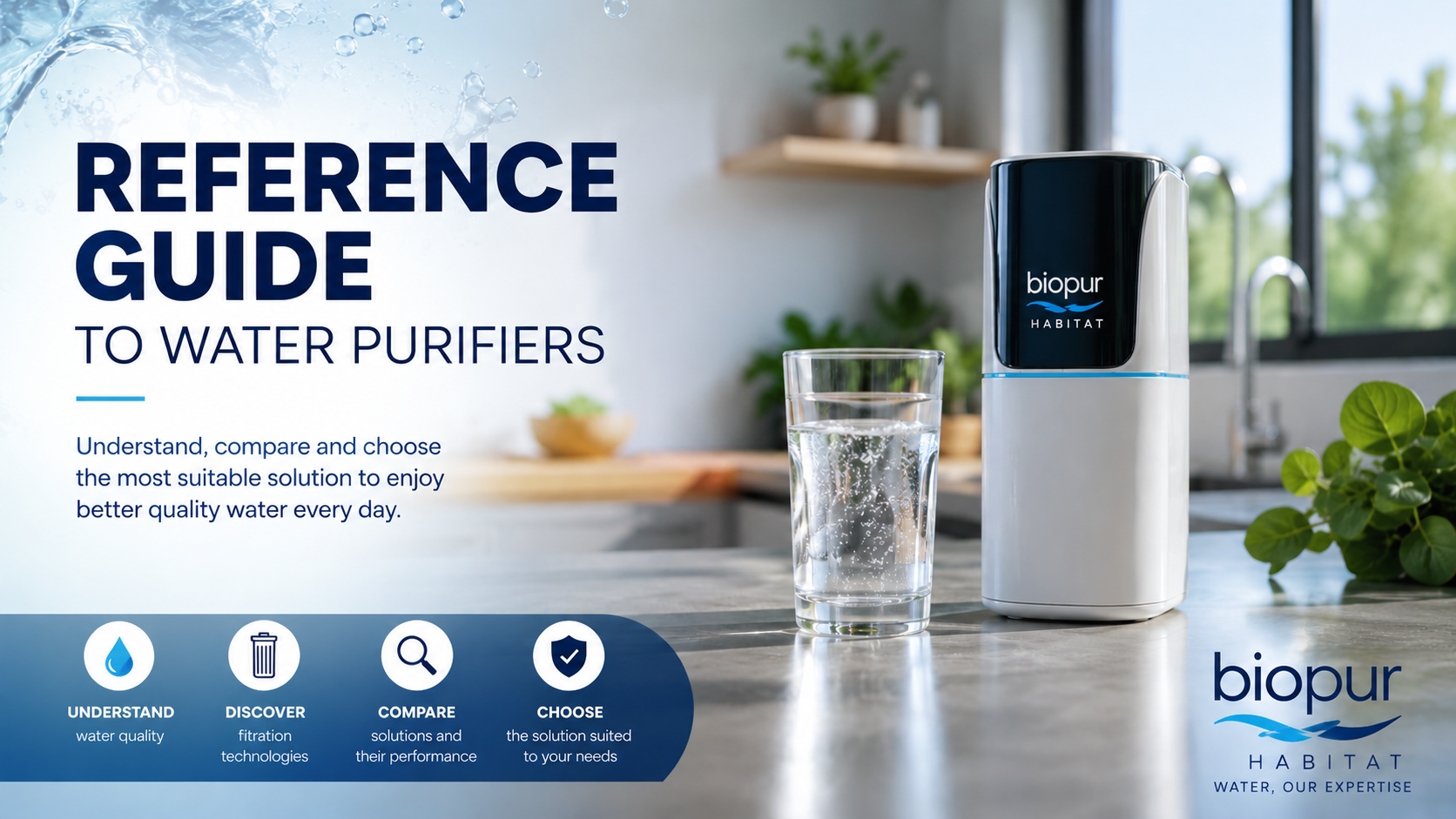
Water Purifier Reference Guide
Understand, compare and choose the most suitable solution to enjoy better-quality water every day.
Water is central to our diet, our health and our well-being. Yet few consumers are truly aware of its composition, the treatment it undergoes before reaching the tap, or the technologies available to improve its quality.
This guide has been designed to answer all these questions with one simple aim: to provide you with clear, impartial and informative guidance to help you make informed choices.

Why this guide?
Nowadays, there is a wide range of solutions designed to improve the quality of tap water: filter jugs, tap-mounted filters, reverse osmosis systems, ultrafiltration, activated carbon, UV sterilisation, smart systems…
Given such a wide range of products on offer, it is sometimes difficult to distinguish between sales pitches and genuine technical criteria.
Our aim is not to promote one technology over another, but to explain how they work, their advantages, their limitations and their areas of application.
You will also find out what contaminants may be present in water, how they are treated, what standards govern drinking water quality, and in which situations a water purification system might actually be beneficial.
A guide designed to last
Unlike many articles available online, this guide has not been designed to answer a specific question.
This is a comprehensive information resource designed to help both members of the public and professionals understand the various domestic water treatment solutions.
The information presented is based on the technical knowledge currently available and will be updated as regulatory, scientific and technological developments occur.
Who is this guide intended for?
Private individuals
Perhaps you simply want to understand the quality of your water, compare different technologies, or choose a water purifier that’s right for your home.
Families
Are you looking for high-quality water for everyday drinking, cooking or making baby bottles?
Professionals
Fitters, tradespeople, retailers or construction professionals looking for a reliable resource.
Curious
You enjoy understanding how the technologies around you work and want to look beyond common misconceptions.
“Understanding your water better means being able to make an informed choice.”
What you’ll find out in this guide
Choosing a water purifier is not just a matter of comparing prices or brands. Before making any decision, it is essential to understand the quality of the water you consume, the treatment already carried out by the water supply companies, any contaminants that may still be present, and the various filtration technologies available.
This guide has been designed to serve as a comprehensive reference work. Whether you are a private individual looking to improve the quality of your water, someone considering purchasing a filtration system, or simply curious to gain a better understanding of what you drink every day, you will find clear, well-researched and accessible information here.
Each chapter answers a specific question and will enable you to progress step by step, without the need for any prior technical knowledge.
Our commitment
The aim of this guide is not to persuade you to buy a particular device.
Our priority is to help you understand the issues surrounding drinking water quality so that you can make an informed decision on whether or not to choose a water purification solution.
Because making the right choice always starts with the right information.
Contents of the guide
Click on a chapter to go directly to the relevant section.
Reading recommendation
Even if you’ve come here looking for specific information, we recommend that you start with the first few chapters.
They provide the essential foundations for understanding how the various technologies work and for avoiding the common misconceptions often found on the internet.
Once you have grasped these concepts, you can move on to the technical chapters that interest you most.
Let’s start with a simple but crucial question:
Why are more and more households now choosing to install a water purifier in their homes?
Chapter 1 – Why consider a water purifier?
Tap water in France is one of the most strictly monitored foodstuffs. It undergoes numerous tests throughout its distribution process to ensure it complies with current health standards.
Nevertheless, many consumers are now choosing to install a water purification system in their homes. This does not mean that the tap water is unfit for consumption. It is primarily a response to expectations relating to taste, convenience, the reduction of certain residues, or the desire to have greater control over the quality of the water consumed on a daily basis.

Water that meets the standards is not necessarily perfect water
Health standards set out regulatory thresholds designed to protect the public. These thresholds take into account the available scientific evidence, the technical capabilities of distribution networks and economic constraints.
Water that complies with the standards may nevertheless contain, in very small quantities, certain elements that occur naturally in the environment or result from human activities. Their presence remains within regulatory limits, but may lead some people to seek an even higher standard of quality.
Key points
A water purifier is not designed to make water that is not fit for drinking safe to drink. It is generally used as an additional step to improve certain characteristics of the water supplied.
Expectations that go beyond simple filtration
Users’ motivations vary widely. Some are driven by health concerns, others by everyday convenience, and still others by environmental considerations.
| Motivation | Intended objective |
|---|---|
| Improving the flavour | Reduces chlorine and certain odours. |
| Reducing certain types of waste | To minimise the presence of undesirable substances, depending on the technology used. |
| Looking after your appliances | To reduce the effects of limescale in certain cases. |
| Reducing the use of plastic bottles | To reduce waste and the transport of bottled water. |
| Improving comfort | To have filtered water straight from the tap. |
A rapidly changing market
In recent years, water purification systems have become much more widely available. Technological advances have made it possible to offer equipment that is more efficient, more compact and easier to maintain.
At the same time, information on water quality has become more accessible. Consumers now have access to a wealth of public data on the water supplied in their local area, which helps them make more informed choices.
The right instinct
Before choosing a filtration system, it is essential to understand exactly what is in your water. Not all technologies meet the same needs, and there is no one-size-fits-all solution.
Before comparing the different technologies, it is therefore worth understanding how drinking water is produced, monitored and delivered to your tap.





 English
  Français
  Deutsch
  Italiano
  Español
  Belgium