
No products
Prices are tax included
Tap water: a health hazard or not?
In France, tap water is generally subject to strict monitoring. However, monitoring does not mean constantly testing everything, nor does it mean completely preventing local, temporary or emerging issues. That is why more and more households are seeking to better understand when it is simply a matter of trusting the system, when it is necessary to check, and when it may be useful to filter or purify water at home.
What the public audits reveal
Tap water in France is the most strictly monitored food product. This means that it undergoes regular health checks, with the results made publicly available for each local authority. In the vast majority of cases, it can therefore be consumed without any particular risk provided it meets the required standards.
But the serious answer to the question “Is tap water dangerous?” is neither “yes, everywhere” nor “no, always”. The correct answer is more precise: it is generally safe provided it meets health standards, but there may be local, domestic or temporary circumstances that warrant extra caution.
The limitations of health checks, however thorough they may be
The fact that water is tested does not mean that every conceivable substance is constantly screened for. In practice, routine tests focus on specific regulatory parameters, but they have never claimed to routinely analyse every possible contaminant present in our modern environment.
It is precisely for this reason that health authorities also carry out additional campaigns targeting substances that are rarely, if ever, tested for in routine checks. This does not mean that tap water is “inherently dangerous”, but it serves as a reminder that a health check does not amount to comprehensive monitoring of everything that might be present.
PFAS, pesticides and emerging pollutants: why this issue remains important
PFAS have recently demonstrated that a substance can become a key concern even when it was not previously a focus of historical monitoring. More broadly, monitoring campaigns carried out by health authorities clearly show that certain compounds are the subject of specific attention precisely because they are not, or are only rarely, tested for in routine monitoring.
This does not mean that tap water is generally unsafe. However, it does fully justify a household wanting to take things a step further, particularly if they wish to have greater control over their water supply on a day-to-day basis, or if they prefer to take extra precautions against temporary incidents, emerging pollutants or simply local concerns about water quality.
In other words, public health checks remain essential, but this does not mean that a domestic water purification system cannot serve as a useful additional safeguard in certain contexts.
When should you be more vigilant?
Extra caution is advisable, particularly in the following cases:
- if the water has a strong taste or a smell of chlorine,
- if your home has old plumbing,
- if you live in an area that has previously experienced temporary non-compliance,
- if you’d like water that’s more pleasant to drink, for cooking or for baby bottles,
- if you want extra protection against certain emerging compounds or pollutants.
It is also worth noting that not all water-related issues follow the same logic. Limescale, for example, mainly affects user comfort and the protection of equipment; this is not the same issue as the need to purify drinking water.
Why do some people still prefer to purify their water?
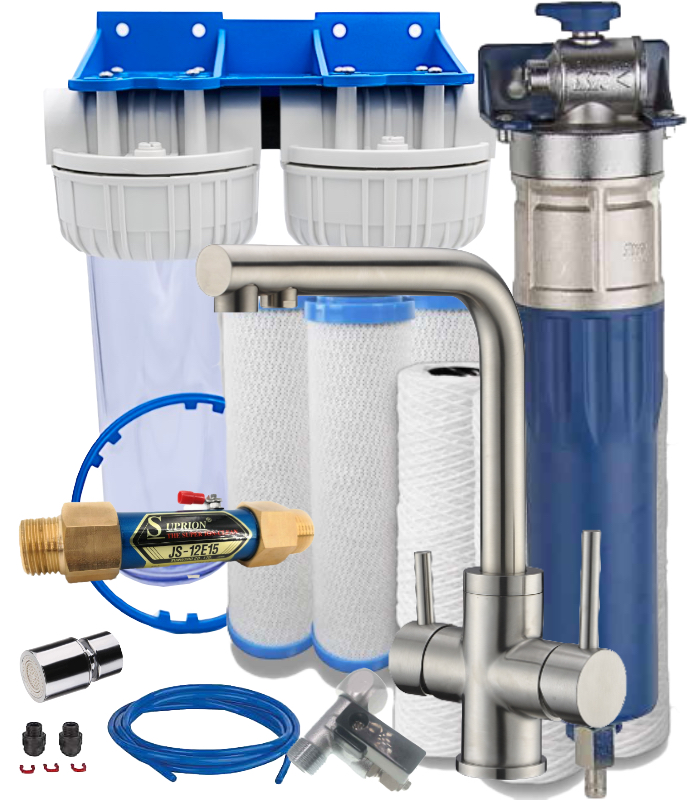
Because a carefully chosen water purification system can provide additional safety. It does not replace official inspections, but it acts as an extra barrier at the point of use, where the water is actually consumed.
In times of uncertainty – whether due to unfavourable local news, an unpleasant taste, concerns about certain pollutants, or simply for greater peace of mind – an under-sink water purifier or a suitable solution can therefore make a lot of sense. This also explains why some households that have already installed such systems do not wait for a crisis to decide to improve their water at home.
Which solution should you choose to suit your needs?
In many cases, the best approach is not to treat everything in the same way, but to choose the right solution for the right place: the water supply, the kitchen or pipes prone to limescale.
Conclusion
To say that tap water in France is “dangerous” would be an exaggeration. To say that it is necessarily perfect in every case would be an exaggeration too. The most sensible view is to acknowledge that it is generally subject to very strict controls, whilst recognising that not everything is constantly monitored and that local, temporary or emerging issues do arise.
That is why a carefully chosen filtration or purification system can be very useful: not to replace official checks, but to provide extra protection, greater peace of mind, and better control over the water we actually drink every day.
FAQ – Tap water and health
Is tap water harmful to your health?
Generally speaking, no, provided it complies with the rules. However, certain local, domestic or temporary circumstances may warrant particular caution.
Why do some people prefer to purify their water?
Because a purification system can provide an additional barrier against certain tastes, odours, pollutants or temporary drops in water quality.
Are public inspections always enough to detect everything?
Regulatory checks are essential, but this does not mean that every possible substance is routinely tested for in routine analyses.
Which system should you choose for drinking water?
When it comes to the water you actually drink every day, the most sensible option is often an under-sink water filter or a point-of-use system.
Related products
Leave a CommentLeave a Reply
Blog archives
Blog categories
Latest Comments

BIOPUR habitat
on How to get rid of the limestone !!!
BIOPUR habitat
on Water Softener and Limescale Remover Part 3,...
BIOPUR habitat
on Which water flow rate depends on the pipe diameter
BIOPUR habitat
on Water softener or anti-limescale filter: what...
Blog search
Related articles

Bottled water dangerous to health ?
2016-09-25





 English
  Français
  Deutsch
  Italiano
  Español
  Belgium